Falling Pickaxe strategy for smarter play
Falling Pickaxe uses random outcomes, so the sensible approach is to understand the mechanics, control your stake and stop chasing losses.
Time to Register
You've been playing the free demo for 10 minutes. Register now to play with real money and claim your welcome bonus.
Join NowIn Falling Pickaxe, a pickaxe falls through destructible blocks until its HP runs out, collecting qualifying rewards along the way. A useful strategy therefore starts with the rules, not a secret pattern: understand the block values, set a session budget in pounds, and decide when to stop before the animation pulls you into another round. The game comes from Pixmove Games, with 95% RTP, low volatility and a maximum win of x160.
📑 Table of contents
- Can you guarantee a win in Falling Pickaxe?
- Understand the mechanics before playing
- A practical stake sizing strategy
- Special objects and realistic expectations
- When Auto Spins make sense
- RTP, volatility and sensible expectations
- How to investigate a suspected error or hack
- Demo play is a safe interface workout
- Responsible play for adults aged 18 and over
- Explore more Falling Pickaxe pages
- FAQ
1 Can you guarantee a win in Falling Pickaxe?
No. Every round in Falling Pickaxe depends on a random number generator, so there is no guaranteed win, reliable hack or secret sequence that can predict the next result. Strategy can help you choose a stake, limit the length of a session and leave at a sensible point; it cannot turn random outcomes into a certainty. If you want to compare this view with player experiences, read the Falling Pickaxe reviews, while keeping anecdotes separate from evidence.
What you can control as a player
Before spinning, you can choose the stake, session length and stopping rules. In the UK, the stake is shown in pounds, with the available range running from £10 to £20,000. You can also choose between demo play and real money, read the rules, select whether to use features such as Auto, and stop when your planned limit is reached. During a round, watch the pickaxe HP and the displayed WIN rather than relying on excitement alone.
- Set a session budget in GBP.
- Choose a small stake for each round.
- Decide your loss and win limits before you begin.
- Pause if tiredness or the urge to recover losses takes over.
What does not change the game’s maths
The time of day, a run of previous results, a different device and so-called hot blocks do not create a proven advantage. The previous round cannot tell you what comes next. Raising BET after a loss changes how quickly your balance may fall, but it does not improve the random odds. This remains true whether you are playing from London, Manchester or elsewhere in the UK.
2 Understand the mechanics before playing
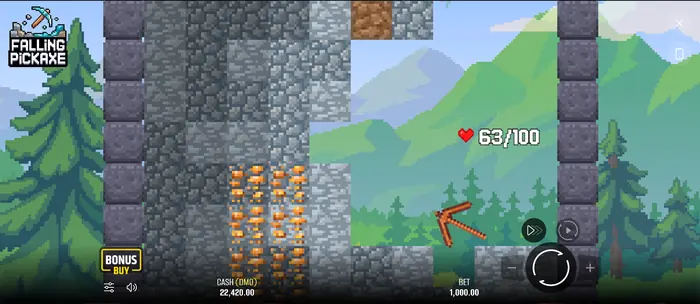
Falling Pickaxe is a single-reel slot with a variable falling-physics grid. Each spin produces either a cross with no pickaxe or one of four pickaxes: Wooden, Stone, Iron or Diamond. The selected pickaxe falls through blocks, and the round ends when its HP reaches zero. Each hit reduces both the pickaxe’s HP and the active block’s HP by 1; rewards gathered during the round are added together and paid when the pickaxe is exhausted.
| Pickaxe | HP |
|---|---|
| Wooden | 100 |
| Stone | 150 |
| Iron | 200 |
| Diamond | 400 |
If seven spins in a row end with a cross, the eighth spin is guaranteed to produce one of the four pickaxes. The screenshot shows where the main game indicators sit.
How to read the active blocks
Do not judge a block only by its colour. Dirt and Stone each have 1 HP and pay nothing, while the ore blocks require more hits and carry different rewards. Use the in-game rules and paytable when checking a cell:
| Block | HP | Reward |
|---|---|---|
| Dirt | 1 | £0 reward |
| Stone | 1 | £0 reward |
| Copper | 5 | x0.01 of the stake |
| Redstone | 10 | x0.05 of the stake |
| Gold | 15 | x0.2 of the stake |
| Diamond | 20 | x1 of the stake |
| Emerald | 30 | x5 of the stake |
The multiplier is applied to your stake, not converted into a fixed cash amount without knowing the stake.
Track pickaxe HP and WIN
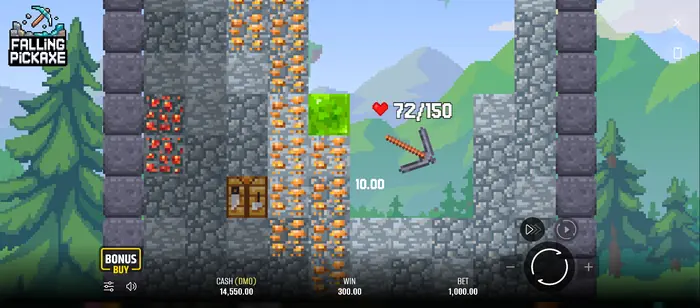
During a round, check the pickaxe hearts and the running WIN figure in the lower panel. A lively destruction animation can continue without meaning that your available balance has increased, so keep the visual effects and the actual result separate. Once the pickaxe reaches zero HP, the accumulated rewards are settled. The screenshot highlights the indicators worth watching.
3 A practical stake sizing strategy
Base the stake on the budget for this session, not on a wish to recover an earlier result. Choose a modest amount per round, record a maximum loss and set a stop-win before pressing Spin. In the UK, that means planning in pounds and checking that the operator accepts players from the United Kingdom. The available stake range is £10 to £20,000, but the minimum is not a sensible target for every player. Keep the number small enough that several rounds will not immediately exhaust your budget.
| Before play | Practical action |
|---|---|
| Session budget | Choose the maximum amount you are prepared to lose in GBP. |
| Round stake | Use a small, affordable part of that budget. |
| Stop-loss | End the session when the planned loss limit is reached. |
| Stop-win | Leave when your pre-set profit target is reached. |
A conservative way to begin
For a first look, choose a low stake and keep the session short. That gives you time to find Spin, Auto, Plus and Minus, see how pickaxe HP falls, and learn where WIN appears. It reduces the speed at which your balance is spent, but it does not guarantee a profit or change the game’s underlying randomness. Once the interface feels familiar, there is still no need to lengthen the session automatically.
Why chasing losses is risky
After a losing round, increasing BET can feel like a quick repair. The next result, however, does not know about the previous loss. A larger stake simply makes the same unlucky sequence consume your bank faster, while the earlier loss remains lost. Stick to the limit you chose in advance; taking a break is usually more useful than turning one disappointing round into several expensive decisions.
4 Special objects and realistic expectations
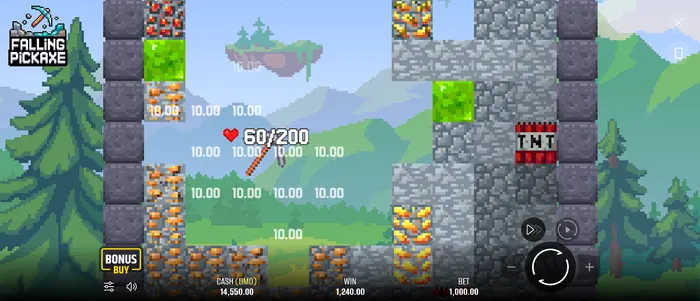
Special objects can change the way blocks are cleared, but none should be treated as a promise of a large payout. Check the official effect of each item before interpreting what you see.
| Object | Observed action | Confirmed effect |
|---|---|---|
| TNT | Explodes when destroyed | Destroys blocks within a defined radius |
| Upgrade Arrow | Widens the pickaxe temporarily | 1.5x its size for 3 seconds; another arrow can raise it to 2x, then 2.5x |
| Workbench | Repairs and improves the pickaxe | Restores HP and advances Wooden to Stone, Stone to Iron or Iron to Diamond; a Diamond pickaxe is fully restored |
These effects can make the screen look dramatic, yet they do not remove the random element of the round.
TNT and cascading visual effects
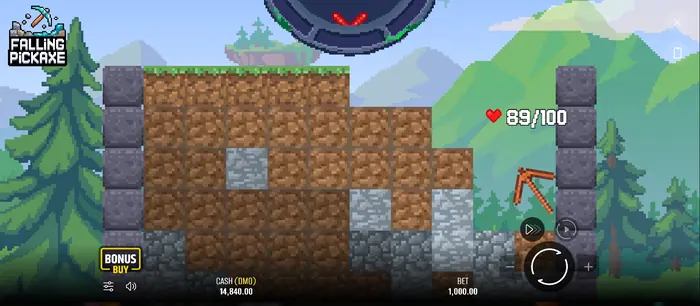
When TNT starts a chain of destruction, the screen may fill with movement and explosions. Count the actual qualifying blocks and check WIN separately; the size of the animation is not the same as the size of the payout. After a cascade, look again at the pickaxe HP and your balance before deciding whether to continue. A spectacular chain is an event in the round, not evidence that the maximum win is about to arrive.
Bonus Buy is a paid option
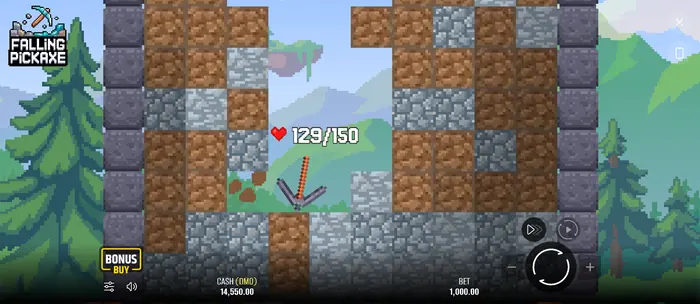
Falling Pickaxe supports Bonus Buy, but buying access to a feature is not a mathematical edge. Compare the displayed price, conditions, RTP information and any operator restrictions with a normal launch before confirming. Keep the purchase inside the budget you set in pounds, and never use it as an emergency attempt to repair a losing session. If the option is unavailable in your UK casino account, do not assume that a similar button will appear later.
5 When Auto Spins make sense
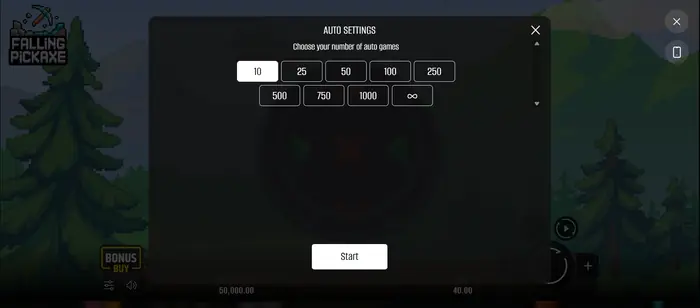
Auto Settings are a pacing tool, not a strategy. Once you understand the interface, select a limited number of automatic spins using the same stake as the spin that activated Auto, then check that the stop behaviour matches your plan. You can press Auto again to stop the sequence. Avoid an uncontrolled, endless run: it makes it easier to miss a drained budget or keep playing after attention has faded. The Turbo control changes animation speed, not the game’s maths.
Stop rules and balance control
Write down the conditions that end the session before you start. Stop when one of these applies:
- Your loss limit has been reached.
- The session budget is gone.
- You are tired, distracted or trying to win back money.
- Your connection is unstable.
- A feature behaves differently from the stated rules.
In the last two cases, do not test the problem with more bets. Save what you can, close the game and check the operator’s information first.
6 RTP, volatility and sensible expectations
Falling Pickaxe has a stated RTP of 95%, low volatility and a maximum win of x160. RTP is a long-term theoretical measure, not a promise for one round or one short session. Low volatility describes the general distribution of results, not guaranteed income. Treat x160 as the stated ceiling rather than a likely outcome, and plan your UK session around money you can afford to lose. Several attractive blocks in a row do not create a new pattern.
7 How to investigate a suspected error or hack
If a round ends unexpectedly or the displayed result looks wrong, preserve the evidence before playing again. Save the round ID, screenshots and game history; note the time and the stake shown in GBP. Do not repeat the disputed bet to recreate the issue. Contact the casino’s support team first, ask them to check the round record, and review the published rules. If the operator does not resolve a genuine issue, follow the relevant UK complaints or regulatory route. A technical fault may also affect or void payouts under the game rules, so do not assume every unusual screen proves a hack.
8 Demo play is a safe interface workout
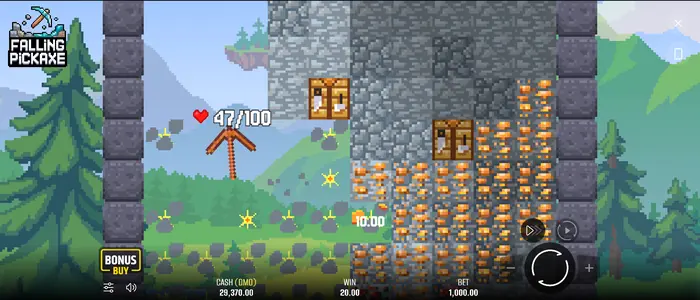
The free version lets you locate the controls, inspect the blocks and see where pickaxe HP and WIN are shown without risking your budget. A demo result does not carry over to real-money play and cannot prove that a system works. If you only need to learn the controls, start with the Falling Pickaxe demo before deciding whether real-money play is appropriate for you.
9 Responsible play for adults aged 18 and over
Only play with money you can afford to lose. Do not borrow to bet, chase losses or raise BET because a previous round went badly. Set deposit, stake and time limits where your operator offers them, and seek support if gambling stops feeling recreational. In the UK, check that the casino accepts British players, displays its 18+ policy and provides suitable safer-gambling tools before you deposit. Use a payment method you control, such as a debit card via Visa or Mastercard, Faster Payments bank transfer, BACS Direct Debit or Open Banking Pay by Bank.
10 Explore more Falling Pickaxe pages
Use the Falling Pickaxe home page to find the game overview and other available sections. From there, you can keep the rules, demo information and player feedback separate from your personal staking decisions.
FAQ
What is the RTP of Falling Pickaxe?
The stated RTP is 95%. That is a theoretical long-term figure, not a prediction for a particular round or a guarantee that a British player will receive that return in one session.
Can I use promo codes in Falling Pickaxe?
That depends on the casino and its current promotion terms. Check the operator’s offers or ask support whether a promo code applies to Falling Pickaxe, whether UK players are eligible, and what wagering or game restrictions apply.
What is Bonus Buy?
Bonus Buy is a paid option that gives access to a bonus feature where the operator makes it available. Check the displayed price, RTP information and conditions before confirming; buying the feature does not make the random result certain.
Can you win at Falling Pickaxe, and can anyone guarantee it?
A player can win or lose because the round outcome is random, but nobody can guarantee a win or predict a particular block sequence. You control the stake in pounds, session length and stopping point, not the RNG result.